The Nature of Peace and the Continuum of Violence in Environmental Conflicts


In 2024, I defended my PhD dissertation in Political Science at Lund University, Sweden.
My supervisors were Dr. Roxanna Sjöstedt (Political Science, Lund University) and Dr. Oriol Sabaté Domingo (School of Economics, University of Barcelona). The opponent was Professor Jan Selby (University of Leeds).
You can find a digital version of the dissertation in the Lund University Library.
In 2025, I was awarded an International Scientific Recognition for the work in the dissertation, as part of the Third International Science Prize by the Hans Günter Brauch Foundation for Peace and Ecology in the Anthropocene.
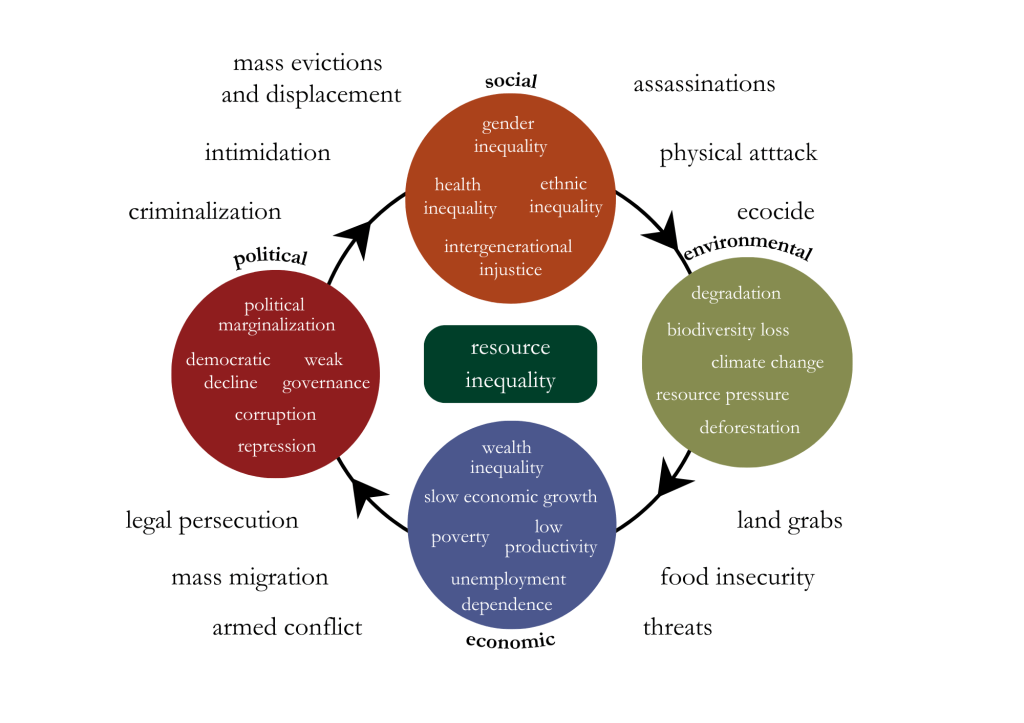
In this dissertation, I aim to explore the links between nature, conflict, and peace building on literature from peace and conflict studies and environmental peacebuilding. I argue that environmental issues, especially related to the distribution of natural resources, are central to understanding structural conditions allowing for both conflict and peace. In order to answer the research question, I explore how nature is understood, valued, and exploited and how this contributes to the creation of unjust structures that promote conflict and violence. I center resource inequality at the root of environmental conflicts, thus providing a structural account of how they affect violence through the idea of the continuum of peace-violence. Ultimately, I show that building sustainable peace requires reshaping structures of distribution of both resources and power to promote not only negative peace but also create the conditions for positive peace.
This dissertation engages both quantitative and qualitative methods embedded into feminist and decolonial methodologies. By integrating these methods, the thesis provides a more holistic view that bridges macro-level patterns with micro-level intricacies, thereby advancing the field of environmental peacebuilding through a more systematic and comprehensive methodological framework. It also addresses recent calls in the field for a more methodologically plural approach to environmental peacebuilding by employing feminist and decolonial methodologies with attention to power dynamics with the aim of negating simplistic narratives.
The papers in this thesis provide not only empirical evidence to substantiate and challenge environmental peacebuilding’s pathways and mechanisms but also help further develop the framework for a more comprehensive and transformational approach to building peace in times of environmental breakdown and climate change. The results of this dissertation highlight the need for a more comprehensive and integrated understanding of peacebuilding that considers the complex interplay between environmental, economic, and social factors. The findings underscore the importance of addressing the underlying structural issues that perpetuate conflict and hinder sustainable peace. By challenging the existing paradigms and proposing alternative frameworks, this research contributes to the ongoing discourse on effectively fostering sustainable peace in post-conflict countries.
My proposed visualization of the feminist continuum of violence in environmental conflicts

My proposed theoretical model centers resource inequality as root causes of conflict
Paper I Negotiating natural resources conflicts: provisions in peace agreements and prospects for building sustainable peace (working paper)
Does the inclusion of natural resources provisions in peace agreements affect post-conflict peace duration? Literature on civil war termination argues that provisions on wealth-sharing have no effect on the duration of post-conflict peace. In contrast, recent literature on environmental peacebuilding argues that natural resources are often root causes of conflict and, therefore, are key to building post-conflict peace. The aim of this article is to investigate the transformation of conflict resources into peace resources and to analyze the prospects for building sustainable peace after natural resources conflicts. First, I explore the role of natural resources provisions in peace agreements and their effect on post-conflict peace. Using newly collected and disaggregated data on natural resources in peace agreements from 1976 to 2018, the analysis shows that including natural resources provisions in peace agreements has a positive effect on post-conflict peace duration. Second, I complement the statistical analysis with a qualitative discussion of the cases of El Salvador, Sudan, and Nepal’s peace processes that substantiate the claim that natural resources can also have a positive effect on peace. The results support the hypothesis that when natural resources are central conflict issues, their inclusion in the negotiation process is important in preventing conflict recurrence and promoting sustainable peace.
Paper II From peace agreements to sustainable peace? Assessing the question of land in Guatemala’s peace process (working paper)
This paper proposes a novel framework for assessing the inclusion of natural resource issues in peace agreements, with a particular focus on land inequality and its implications for sustainable peace. Land inequality, deeply rooted in historical injustices and exacerbated by globalization and large-scale land acquisitions, remains a critical driver of conflict. Through an in-depth analysis of Guatemala, this study illustrates how addressing land issues in peace agreements can help build sustainable peace. By applying parameters from the peace agreement literature, the proposed framework critically evaluates the clarity, inclusiveness, and effectiveness of land provisions in peace agreements. The findings underscore the necessity of an ethical, political, and environmental imperative in environmental peacebuilding to prevent the perpetuation of unequal structures that produce and reproduce violence and conflict. This approach is vital to moving beyond the unintended consequences of peacebuilding efforts that may inadvertently foster new forms of violence and oppression. Ultimately, the study advocates for a normative commitment to a vision of sustainable peace that is beneficial for both people and the environment, ensuring that peacebuilding processes contribute to just and lasting outcomes.
Paper III Beyond the boom: Assessing the effect of extractive industries on development and violence in post-conflict countries (co-authored with Jakob Molinder. Working paper).
Is intensification of resource extraction an effective peacebuilding strategy for post-conflict countries? While restructuring the extractive sector can stimulate economic recovery and support reconstruction, it often leads to human and labor rights violations. This study examines the relationship between resource extraction, violence, and development in post-conflict sub-Saharan Africa, using georeferenced data and grid-cell level analysis to account for local dynamics. Spatial HAC models are employed to address spatial heterogeneity and autocorrelation. Our findings indicate that while extractive industries boost short-term economic growth, they have no discernible impact on human development. Instead, they are associated with increased violence, particularly against civilians. Additionally, state capacity mediates these effects: high-capacity states experience more protests and state repression, while low-capacity states see increased direct violence. These results highlight the need for responsible resource management and strong governance to mitigate the negative impacts of extraction and promote sustainable peace.
Paper IV Room to grow and the right to say no: theorizing the liberatory power of peace in the Global South (published open access in Geopolitics https://doi.org/10.1080/14650045.2023.2286287)
This article builds on feminist and decolonial perspectives and engages with political geography literature to rethink the way that peace and violence are understood in the Global South. Building peace that is coherent with planetary and ecological limits and that does not further direct structural violence necessitates breaking with the extractivist model of development that benefits growth and accumulation over the well-being of humans and more than human lives. By theorising the way that degrowth strategies can be understood as furthering climate resilient peace in the Global South, this article proposes two ways that we can understand peace as a liberatory praxis based on the ‘room to grow’ and ’the right to say no’. Through these two strategies, I aim at centering a liberatory praxis for peace on the need to negate both material and symbolic systems and structures of oppression that produce climate and environmental changes, as well as reproduce direct, structural and cultural violence. A peace praxis focused on the liberation of the Global South identifies that different types of violence linked to climate and environmental changes and underdevelopment are not only connected but that they share their roots in deeper structural systems of extractivism, exploitation and colonisation.
 Bárbara Magalhães Teixeira, PhD